If you have been making pizza at home for any length of time, you know the rabbit hole goes deep. You upgrade your flour, you start cold fermenting your dough, maybe you experiment with a poolish or biga. And eventually, if you spend enough time reading about artisan bread techniques, you stumble onto the autolyse.
For me, the autolyse was one of those techniques that felt almost too simple to matter. You mix flour and water, you walk away for half an hour, and somehow the dough is dramatically better when you come back. Less kneading, easier stretching, better oven spring.
This guide covers everything worth knowing about the pizza dough autolyse - what it actually does at a molecular level, how long to do it for different flours and styles, when it is not worth the trouble, and a reliable recipe to get you started.
What is an Autolyse?
An autolyse is a rest period at the very beginning of the dough-making process where you mix only flour and water together, then leave them alone. Salt, yeast, oil - all of that stays on the counter until the rest is over.
The idea is dead simple: give the flour a head start on absorbing water before you introduce anything else into the mix. The result is a dough that is more extensible, requires less kneading, and develops better flavor and color during baking.
The technique comes from French baking professor Raymond Calvel, who developed it in the 1970s to combat the problems caused by intensive mechanical mixing in French bakeries. Mixers were getting faster and more powerful, which was great for efficiency but terrible for bread quality - all that aggressive kneading was overworking the dough, bleaching the flour's natural color, and stripping out flavor. Calvel's autolyse solved the problem by letting the flour hydrate passively so the mixer had to do far less work.
The science translates perfectly to pizza. Whether you knead by hand or use a stand mixer, giving your flour a quiet head start on hydration pays off every time.
One important distinction: a true autolyse is strictly flour and water. If you see a recipe that tells you to mix everything together and "let it rest for 30 minutes," that is just a rest period - not an autolyse. And if a recipe includes the yeast but holds back the salt, that is sometimes called a "fermentolyse," which is a slightly different technique with slightly different tradeoffs (more on that below).
Why Autolyse Pizza Dough?
You might be wondering why this extra step is worth the wait when you could just throw everything in a bowl and start kneading. It comes down to three things: hydration, enzymes, and oxidation.
Full Flour Hydration
When you dump water onto flour and immediately start kneading, the flour never gets a chance to absorb moisture evenly. Some granules are saturated while others are still dry in the center. The autolyse fixes this by giving every particle of flour time to fully soak up the water at its own pace.
This matters more than you might think. Gluten proteins - specifically glutenin and gliadin - need water to uncoil and bond with each other. In a standard mix, these proteins are still absorbing water while you are simultaneously trying to develop gluten by kneading. With an autolyse, the proteins are already fully saturated when kneading starts, so the gluten network forms much faster and with much less mechanical work.
If you work with high-hydration pizza dough - anything above 68% or so - this matters even more. Wetter doughs are harder to handle and slower to come together during kneading. An autolyse gives you a massive head start that makes the difference between a sticky, frustrating mess and a dough that actually cooperates.
Enzyme Activation
The moment water touches flour, two important enzymes wake up and start working:
Protease breaks down gluten proteins into smaller, more flexible chains. This is what makes autolysed dough more extensible - more willing to stretch without snapping back. If you have ever fought a dough ball that contracts like a rubber band every time you try to open it up, that is a dough with too much elasticity relative to its extensibility. An autolyse shifts that balance. You still get a strong dough, but one that stretches when you want it to instead of fighting you at every step.
Amylase converts complex starches into simple sugars. Those sugars serve double duty: they feed the yeast during fermentation, and they contribute to Maillard browning and caramelization during baking. The result is a crust with more complex color and flavor - the kind of deep golden-to-brown gradient that looks like it came out of a professional oven even if you are baking at 500°F on a pizza steel at home.
Less Oxidation, Better Flavor and Color
This is the benefit most people overlook. When you knead dough, you are folding air into it. Some oxygen exposure is fine - it actually helps strengthen gluten. But extended kneading introduces too much oxygen, which bleaches the carotenoid pigments in the flour and degrades flavor compounds. The result is a dough that goes from the natural creamy-yellow color of wheat to a flat white, and a crust that tastes less interesting.
Because an autolyse lets gluten develop passively before you start kneading, you need far less time in the mixer or under your hands. Less kneading means less oxidation, which means you preserve more of the flour's natural color and the subtle nutty, wheaty flavors that make a great crust taste like more than just bread. This is especially noticeable with high-quality bread flours and 00 flours that have real character worth preserving.
How Long to Autolyse Pizza Dough
Autolyse duration is not one-size-fits-all. The right time depends on your flour, your hydration level, and what you are trying to achieve. Here is how I think about it.
20 to 30 Minutes (The Standard)
This is where most home pizza bakers should start. A 20 to 30 minute autolyse is enough for the flour to fully hydrate, for the gluten to begin forming passively, and for the dough to become noticeably smoother and more cooperative when you start kneading. For a standard pizza dough hydration in the 60-65% range using all-purpose or bread flour, this is all you need.
If you are short on time, even 20 minutes makes a real difference compared to no autolyse at all. You will feel it immediately when you start kneading - the dough comes together faster and with less effort.
45 Minutes to 2 Hours (Strong Flours and High Hydration)
If you are working with a very strong bread flour (13%+ protein) or a professional-grade 00 like Caputo Pizzeria Blue, those tightly-wound gluten proteins take longer to fully hydrate and relax. Pushing the autolyse to 45 minutes or even an hour or two gives the protease enzymes more time to work, resulting in a dough that is significantly more extensible.
This longer range is also where you want to be if you are pushing hydration above 68-70%. The extra rest time lets the flour absorb water more completely, which means less free water sloshing around when you start incorporating salt and yeast. If you have been struggling with sticky pizza dough at higher hydrations, a longer autolyse might be the fix.
Beyond 2 Hours (Proceed with Caution)
I would not push an autolyse past 2 hours at room temperature. The protease enzymes do not have an off switch - they keep breaking down gluten proteins the entire time. A 30-minute autolyse gently relaxes the gluten. A 4-hour autolyse can over-degrade it, leaving you with a slack, soupy dough that tears easily and will not hold its shape.
If your schedule forces a longer gap between mixing and kneading, you can refrigerate the flour-water mixture to slow enzyme activity. But at that point, you are adding complexity for diminishing returns. Better to just keep it under 2 hours.
A Note on Water Temperature
This is a detail most autolyse guides skip. Enzyme activity is temperature-sensitive - warmer dough means faster enzyme action, and cooler dough slows it down.
If you only have time for a short autolyse (20 minutes), using slightly warmer water (around 80-85°F / 27-29°C) can help compensate by speeding up hydration and enzyme activity. If you are going longer (1-2 hours), stick with room temperature water (68-75°F / 20-24°C) so the enzymes work at a controlled pace and do not overdo it.
In general, aim for a dough temperature between 68-77°F (20-25°C) during the autolyse. This is a comfortable range where hydration happens efficiently without runaway enzyme activity.
Autolyse vs. Fermentolyse: Does the Yeast Go In?
This is a point of genuine debate, and you will see recipes handle it both ways.
A strict autolyse is flour and water only. No yeast, no salt, no oil, nothing else. This is what Calvel intended, and it is what most professional bakers mean when they use the term.
A fermentolyse includes the yeast (or sourdough starter) along with the flour and water, but still holds back the salt. The logic is that fermentation begins during the rest period, giving you a slight head start on flavor development. Some bakers prefer this because it makes incorporating the yeast easier - adding dry yeast to an already-smooth autolysed dough can be awkward, since the dough does not want to absorb new dry ingredients after it has already come together.
Why salt always stays out: Salt is hygroscopic - it pulls water away from flour particles and competes with gluten proteins for moisture. It also tightens the gluten network and inhibits enzyme activity. Adding salt during the autolyse undermines the entire purpose of the technique. You will notice that the moment you sprinkle salt onto your autolysed dough, it stiffens noticeably. That tightening is exactly what you are trying to delay.
My preference for pizza is the strict autolyse - flour and water only. The fermentation head start from a fermentolyse is negligible when you are doing a 24-72 hour cold ferment anyway, and keeping the yeast out gives the enzymes their cleanest window to work. But if you find it easier to include the yeast up front, it is not going to ruin your pizza.
How to Autolyse Pizza Dough (Step by Step)
The process is almost embarrassingly simple. Here is exactly what I do.
1. Weigh your flour and water. Use a kitchen scale - not cups. Baker's percentages and consistent results depend on accurate weights. If you want exact measurements dialed in for your specific dough ball count and hydration target, the PizzaLogic dough calculator handles all the math.
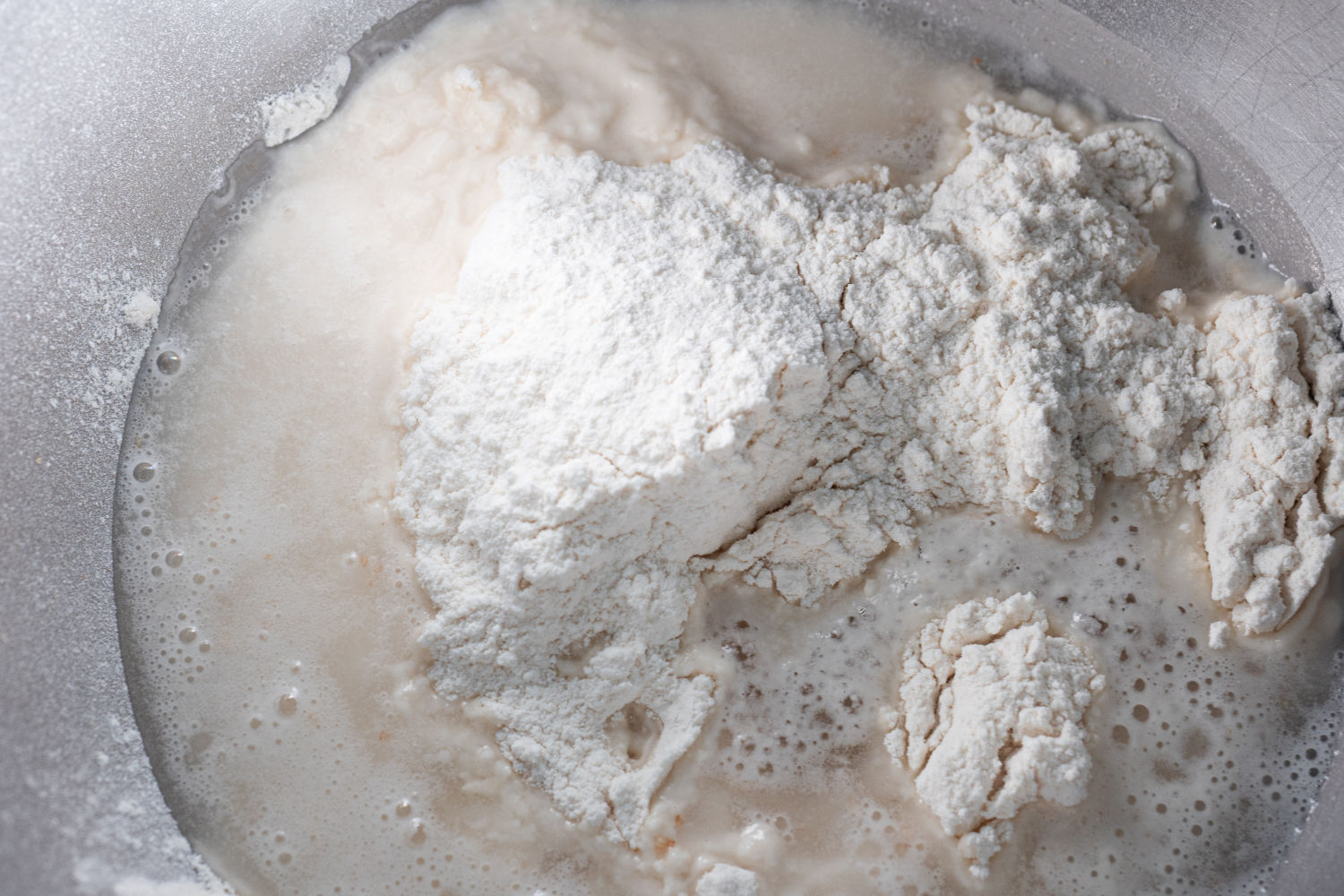
2. Combine and mix until shaggy. Dump the flour and water into a large bowl and stir with a wooden spoon, a fork, or just your hand. Mix only until there are no dry flour pockets left at the bottom of the bowl. It should look rough and messy - that is fine. You are not developing gluten here, just making sure every bit of flour has contact with water.
3. Cover and walk away. Put a damp towel, plate, or plastic wrap over the bowl so the surface does not dry out. Set a timer for 30 minutes (or longer, depending on your flour - see the timing section above). Go do something else.
4. Add yeast, salt, and oil. When the timer goes off, uncover the dough. It should already look smoother and feel softer than when you left it. Sprinkle the yeast and salt evenly over the surface. If your recipe calls for olive oil, add it now too.
Here is where it gets slightly tricky: the dough has already come together into a cohesive mass, so it does not want to absorb dry ingredients the way a shaggy initial mix does. The easiest approach is to pinch and fold the dough repeatedly - literally grab a section, pinch salt and yeast into it, fold the dough over, rotate, and repeat. Some bakers dissolve the yeast in a tablespoon of reserved water to make incorporation easier. Either method works.
5. Knead until smooth. Knead the dough by hand for 5 to 8 minutes, or in a stand mixer on low speed for 4 to 5 minutes. You will notice the dough comes together faster than you are used to - that is the autolyse doing its job. The dough is done when it is smooth, slightly tacky, and passes a basic windowpane test (you can stretch a small piece thin enough to see light through without it tearing).
6. Proceed with your normal fermentation. From here, you are back on your regular schedule - bulk rise, divide, ball, and ferment however you normally do. If you are not already cold fermenting, do yourself a favor and try it. The combination of an autolyse with a 24-72 hour cold ferment is one of the best one-two punches in home pizza making.
When NOT to Autolyse
The autolyse is a great tool, but it is not mandatory for every dough. There are situations where it adds hassle without much payoff.
Same-day doughs at low hydration. If you are making a quick pizza dough at 58-62% hydration with standard all-purpose flour, the flour hydrates quickly enough during normal kneading that an autolyse does not add much. The technique shines most at higher hydrations and with stronger flours.
Freshly milled or whole wheat flours. This is counterintuitive, but whole grain flours with a lot of bran can actually become too slack during a long autolyse. The bran's sharp edges cut through gluten strands, and the extra enzyme activity from whole grains (which tend to have higher amylase levels) can degrade the structure faster than you want. If you are using a significant percentage of whole wheat, keep the autolyse short (15-20 minutes max) or skip it entirely and use stretch-and-fold techniques during bulk fermentation instead.
Flours with a very low falling number. Falling number is a measure of enzyme activity in flour - a low number means high amylase activity. If your flour already has aggressive enzyme activity (common in some European-style flours and flours made from sprouted grain), a long autolyse can tip things too far, giving you a gummy, slack dough. This is a niche concern, but worth knowing about if you are experimenting with unusual flours.
Doughs that use a preferment. If your recipe already includes a poolish or biga, the flour in that preferment has already been hydrating and developing for hours. You can still autolyse the remaining flour and water in the final dough, but the benefit is smaller because a large chunk of your flour is already fully hydrated. It is an extra step with a smaller return.
Autolyse Pizza Dough Recipe
Here is a straightforward recipe built around the autolyse technique. It sits at roughly 68% hydration - high enough to give you a light, open crumb with good oven spring, but manageable enough that you are not fighting the dough during shaping. This makes three dough balls, each around 285g, which is a good size for a 12-inch pizza.
Ingredients
- 500g bread flour (12-13% protein, or a strong 00 flour - see the flour guide if you are not sure what to use)
- 340g water, room temperature (68% hydration)
- 10g fine sea salt (2%)
- 2g instant yeast (0.4%)
- 10g extra virgin olive oil (optional - helps with browning in home ovens)
If you want to adjust the number of dough balls, hydration, or ball weight, the PizzaLogic dough calculator will generate exact measurements and step-by-step instructions for your specific setup.
Instructions
Autolyse: Combine the 500g of flour and 340g of water in a large mixing bowl. Mix with a spoon or your hand until everything is incorporated and no dry flour remains. It will look rough and shaggy. Cover the bowl and let it rest at room temperature for 30 to 45 minutes.
Incorporate remaining ingredients: Uncover the dough - it should already feel smoother and more pliable. Sprinkle the 10g of salt and 2g of instant yeast evenly over the top. If you are using olive oil, pour it on now. Pinch and fold the dough to work everything in. The salt will feel gritty at first, but keep folding until it is fully absorbed.
Knead: Knead for 5 to 7 minutes by hand, or 4 to 5 minutes in a stand mixer on speed 1-2. The dough will tighten up and become smooth. Compared to a non-autolysed dough, you will notice it reaches this point faster and with less effort.
Bulk rise: Shape the dough into a ball, place it in a lightly oiled bowl, and cover. Let it rise at room temperature for 1.5 to 2 hours, or until it has roughly doubled.
Divide and cold ferment: Divide the dough into three equal pieces (about 285g each). Shape each piece into a tight ball - tuck the edges under and rotate the ball on an unfloured surface to build tension on the top. Place each ball in an individual airtight container (lightly oiled) and refrigerate for 24 to 72 hours. The longer cold ferment will develop more complex flavor and make the dough easier to stretch.
Bake day: Pull the dough out of the fridge about 1.5 to 2 hours before you plan to bake. Let it come to room temperature on a lightly floured surface, covered loosely. When it is relaxed and puffy, it is ready to stretch. If you are using a pizza stone or steel, make sure it has been preheating for at least 45 minutes to an hour at your oven's maximum temperature. Use semolina or a semolina-flour blend on your peel to prevent sticking.
You will notice the difference in handling immediately. The dough stretches out smoothly without snapping back, holds its shape on the peel, and puffs up beautifully in the oven. Once you bake with an autolysed, cold-fermented dough, it is hard to go back to a straight mix.
Frequently Asked Questions
Can I autolyse in the fridge overnight? I would not recommend it. An overnight autolyse at room temperature will over-degrade the gluten, and even in the fridge, 8-12 hours is pushing it for most flours. Enzyme activity slows in the cold but does not stop. Stick to 2 hours max at room temperature, or 4 hours max in the fridge if you absolutely need the scheduling flexibility.
Does the type of flour change how long I should autolyse? Yes. Fine-milled 00 flours hydrate faster and need less time (20-30 minutes is plenty). High-protein bread flours with coarser particle sizes benefit from a longer rest (30-60 minutes). Whole wheat flours should get a shorter autolyse (15-20 minutes) due to their higher enzyme activity and bran content. And if you are blending flours, base your timing on whichever flour makes up the majority of the mix.
Is an autolyse the same thing as a pre-ferment? No. A pre-ferment (like a poolish, biga, or sourdough starter) includes yeast and undergoes active fermentation over many hours. An autolyse is just flour and water sitting together - there is no yeast, no fermentation, and the rest period is much shorter. They are different techniques that serve different purposes, though they work well together.
Can I combine an autolyse with a poolish or biga recipe? Absolutely. If your recipe uses a poolish or biga, you can autolyse just the remaining flour and water from the final dough while the preferment does its thing. When the autolyse is done, add the preferment along with the salt and any remaining ingredients. The flour in the preferment has already hydrated during its long fermentation, so the autolyse is only needed for the fresh flour in the final mix.
My dough got really sticky after adding salt and yeast. Is that normal? Temporarily, yes. Adding salt draws moisture out of the dough surface, and the yeast granules can create slippery spots. Keep folding and pinching - it will come back together within a minute or two. If you find it particularly annoying, try dissolving the yeast in a tablespoon of water held back from the autolyse before adding it.
Does an autolyse make a difference if I am kneading in a bread machine? It can, especially for reducing mixing time and preventing the dough from overheating. Bread machines generate a lot of friction, and a shorter knead after an autolyse means less heat buildup. Just autolyse the flour and water in a separate bowl, then transfer to the bread machine pan before adding the other ingredients and running the dough cycle. For more on that workflow, see the bread machine pizza dough guide.