If you're using the PizzaLogic calculator - or any recipe that calls for weights - you already know the recipe gives you gram measurements. Flour: 500g. Water: 325g. Salt: 12g. Yeast: 0.6g.
Most people grab a kitchen scale, knock out the first three without thinking, and then hit a wall on that last one.
Here's the thing: a standard kitchen scale can't reliably measure 0.6 grams. If yours says it can, it's lying to you - or at least giving you a number that's close enough to be wildly off in practice.
The solution is two scales. A kitchen scale for everything else, and a jeweler's scale for yeast - or any small ingredient where your amount dips below about 2g. At that point, a standard kitchen scale's ±0.5g rounding error stops being a rounding error and starts being a meaningful percentage of the measurement itself. This guide explains why, and what to look for in both.
In Baking, Weight Beats Volume Every Time
Before getting into scale specs, it's worth understanding why measuring by weight is so much better in the first place.
Measuring cups are inconsistent in ways you can't see. Flour is the worst offender. Depending on how you scoop, how packed the bag is, or how humid your kitchen is that day, a "cup" of bread flour can range from about 120g to over 160g. That's a 30%+ swing in your most important ingredient - and your dough will feel completely different from batch to batch even when you think you followed the same recipe.
Weight doesn't have this problem. 500g of flour is 500g of flour, every time, regardless of how it settled in the bag or who scooped it.
The same principle applies to salt, oil, and sugar - though the variation is less dramatic than flour. With water it's less of an issue, but using a scale there too means you're not transposing ounces to milliliters or making any mental math errors.
This is why professional bakers work in grams and baker's percentages. The PizzaLogic calculator is built around this same logic - every ingredient is expressed as a percentage of flour weight, so your ratios stay consistent whether you're making dough for two pizzas or twenty. Switching to a pizza dough scale is the single fastest way to make your results more consistent.
What to Look for in a Kitchen Scale
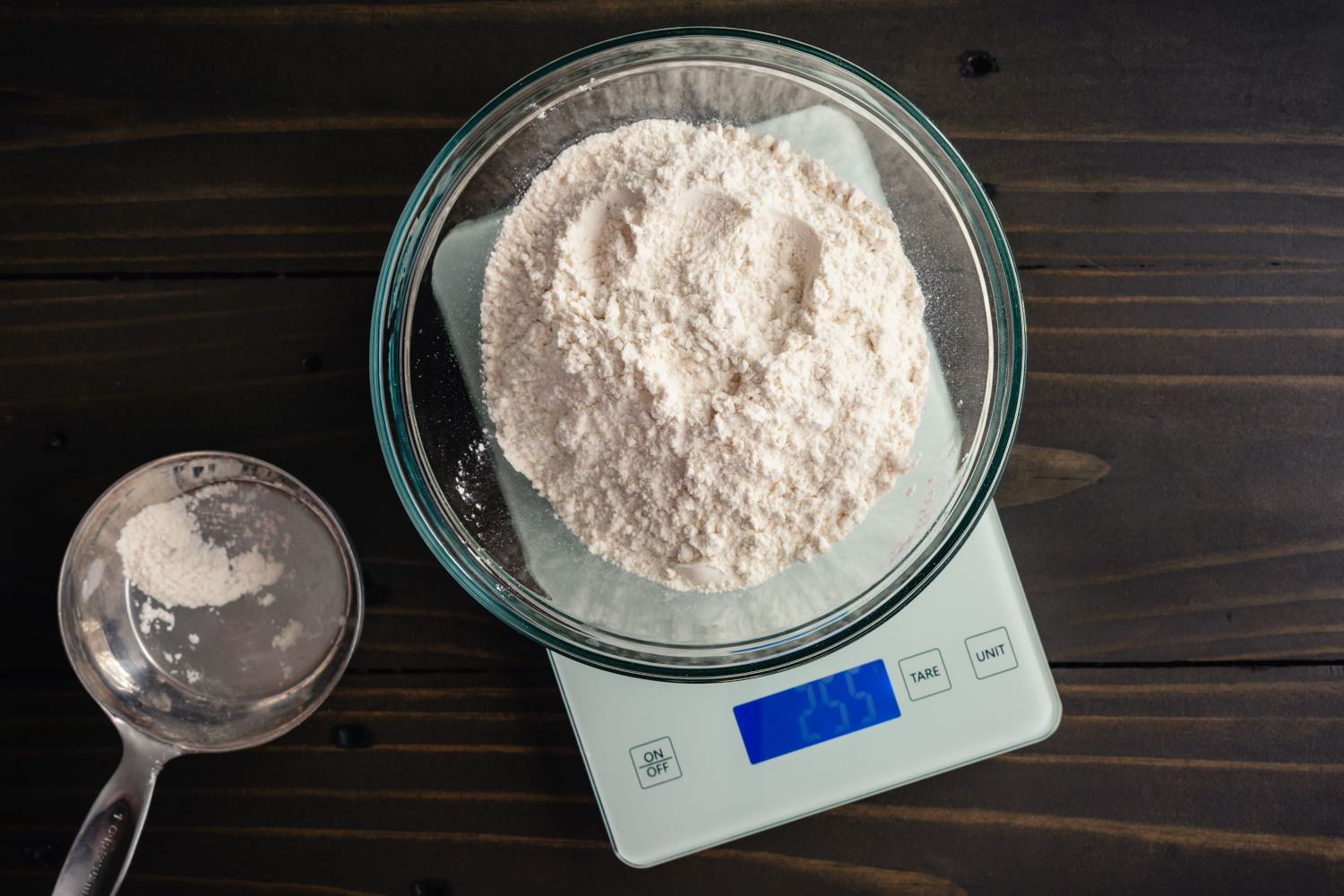
For flour, water, salt, oil, and sugar, a standard digital kitchen scale does the job well. A few things matter:
Capacity and resolution. You want at least 5kg capacity to handle larger batches. The resolution - the smallest increment it can measure - is usually 1g on most consumer kitchen scales. That's fine for flour and water, but we'll get to why it falls apart with yeast in a minute.
A tare function. This lets you zero out the scale with your bowl or container on it, so you're only measuring the ingredient, not the container weight. Every decent kitchen scale has this, but double-check.
A flat, easy-to-clean platform. Dough is messy. A removable stainless steel platform is easier to deal with than a built-in plastic one.
Units. Make sure it can display grams. Some budget scales are primarily set up for ounces and the gram mode is an afterthought.
For most people, a kitchen scale in the $25 - $50 range is more than adequate as a pizza dough scale. You don't need anything fancy. OXO, Escali, and Etekcity all make reliable options in this range.
The Yeast Problem
Here's where things get interesting.
The calculator outputs yeast amounts that are calibrated to your fermentation schedule - time, temperature, and method. For a cold fermentation scenario, that might mean 0.2g or 0.4g of instant dry yeast for a two or three-ball batch. For a same-day dough at room temperature, you'll use more - but it still might only be 1g or 2g total.
These are small numbers. And yeast is not a forgiving ingredient when you get them wrong.
Too much yeast and your dough over-ferments - it gets gassy, the gluten structure weakens, and you end up with a flat, dense crust that tastes boozy. Too little and the fermentation stalls, the dough doesn't develop properly, and you bake something pale and bready with no real structure.
The difference between 0.3g and 0.6g of instant dry yeast is the difference between a properly fermented dough and one that's pushing the edge. These amounts matter.
Now try to measure 0.3g on a kitchen scale with 1g resolution. Even if the display shows you something, it's essentially guessing. The scale can't distinguish 0.1g from 0.5g - they might both round to "0g" or "1g" depending on where you are in that gram's range.
This is why you need a second scale.
Enter the Jeweler's Scale
A jeweler's scale - also called a precision scale or pocket scale - has a resolution of 0.01g. That means it can read to the hundredths place. Where a kitchen scale sees "0g" or "1g," a jeweler's scale shows you "0.27g" or "0.54g."
This is exactly what you need for weighing small amounts of yeast. You can dial in 0.30g with actual confidence, instead of guessing with a teaspoon or hoping your kitchen scale's display is telling you something meaningful.
These scales are also used for weighing coffee, spices, herbs, and in the case of their original purpose, precious metals and gemstones. They're not pizza-specific, which is also why they're cheap. A decent jeweler's scale runs $10 - $20 on Amazon, and they're consistent.
A few things to look for:
0.01g resolution. This is the spec that matters. Some scales advertise 0.1g resolution, which is better than a kitchen scale but still not precise enough for sub-gram yeast measurements. You want 0.01g.
Capacity around 100g - 200g. The trade-off for that 0.01g precision is a low maximum capacity - most jeweler's scales top out at 100g to 500g. That's plenty for yeast and small amounts of other ingredients, but it's why you can't use one for everything. A 500g batch of flour would max it out instantly. This is the fundamental reason you need both scales rather than one that does it all.
A calibration weight. Many jeweler's scales ship with a small calibration weight (usually 10g or 50g) so you can verify the scale is accurate before you use it. This matters more here than with a kitchen scale because the precision is higher and a slight drift means more.
A wind shield or cover. At 0.01g resolution, even a small air current can affect the reading. Most jeweler's scales have a small plastic cover or come with a protective lid for this reason. Measure in a calm spot - away from vents or fans.
How to Weigh Yeast
Once you have a jeweler's scale, the process is straightforward.
Place a small bowl, piece of parchment paper, piece of foil, or mason jar lid on the scale and tare it to zero. Add your yeast slowly - it's light and tends to clump slightly, so a small spoon works better than pouring directly from the bag. Tap gently until you hit your target weight, then add it to your dough as normal.
A few practical notes on this:
If your recipe calls for less than 0.05g of yeast, you're probably working with a very long ferment or a very small batch. At that point, one approach is to scale up to a batch size where your yeast amount lands somewhere more measurable - even 0.15g is easier to work with than trying to hit 0.04g reliably.
The type of yeast also affects how critical precision is. Instant dry yeast (IDY) is the most potent and the most sensitive to small measurement differences. Active dry yeast requires slightly more by weight and has a touch more margin for error. Fresh yeast is used in larger quantities (roughly 3x the IDY amount by weight), which puts your measurements in a range where even a kitchen scale can be more useful - though a jeweler's scale still won't hurt.
The Two-Scale Setup
To recap: a kitchen scale handles everything except yeast. A jeweler's scale handles yeast. Together, they cover the full range of what the calculator asks for.
This isn't about being obsessive. It's about the fact that the calculator does precision math - it accounts for fermentation time, temperature, hydration, and batch size to give you calibrated amounts. If you're then eyeballing the yeast with a measuring spoon or rounding to the nearest gram, you're throwing away the precision that makes those calculations useful.
A kitchen scale costs $30. A jeweler's scale costs $15. That's a one-time $45 investment that makes every batch you mix more consistent - and it's the best scale for pizza dough because it's actually two scales doing two different jobs.
Once you have both, measuring ingredients becomes the least stressful part of the whole process. Which is how it should be.
Ready to put your scale to work? Use the PizzaLogic dough calculator to get exact gram weights for any style, batch size, and fermentation plan.